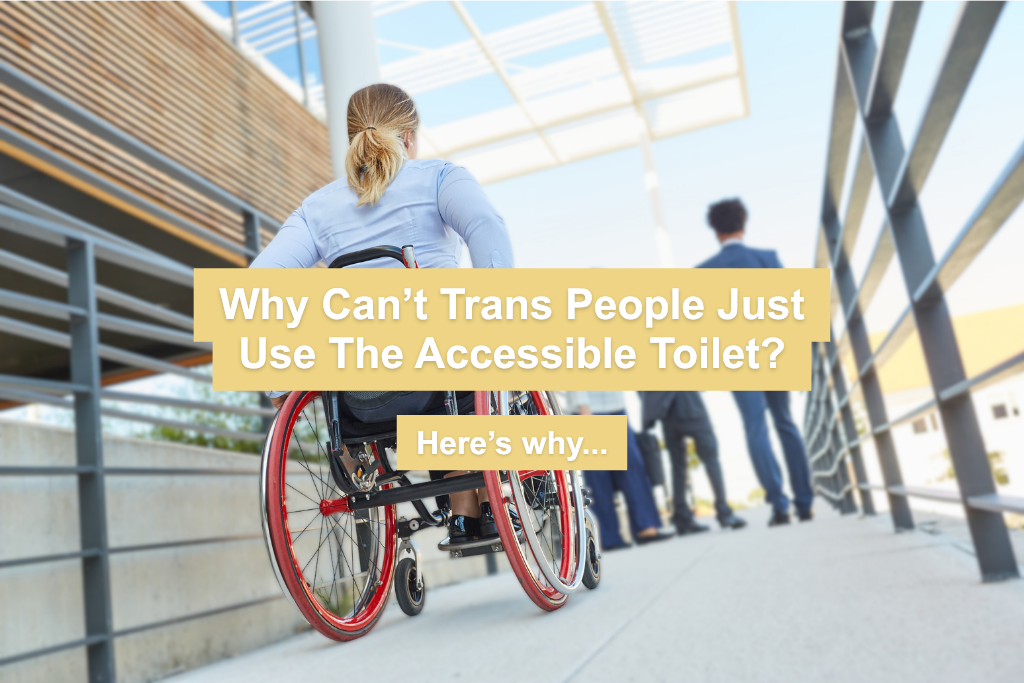
As a disabled person, every time I hear a relatively sensible person say “Why can’t trans people just use the accessible toilet?” It makes my heart sink. Not for the reason you might think, I have ZERO issues with people using the facilities designated for those with access requirements, and I would have my trans siblings side by side with me in any space – with pride. The reason my heart sinks is because I know how it feels to be an afterthought.
It’s usually said with good intentions – as if the accessible space is a kind of catch‑all solution for anyone who doesn’t fit neatly into the boxes society has built. But here’s the thing: Accessible spaces are fast becoming the equivalent of the ‘miscellaneous drawer’ (that we all have, right?!) where you put something when you don’t know where else to put it.
Why we need accessible facilities
Accessible facilities exist for a very important reason. In principle they should be thought out and designed in a way which helps those who are excluded, due to having additional needs, to feel part of society, and in doing so reduce barriers to full participation. Signage and information that describes the facilities instead of their users would be an improvement for the disabled, neurodivergent and trans+ community, while also acknowledging the intersectionality of these groups.
For many disabled people, accessible toilets aren’t optional. They’re the only place we can safely, privately, and with dignity manage our bodies. In my case, the presence or absence of them can make the difference between being able to simply be, and enjoy, wherever it is I am, or the alternative: leave early or not attend at all.
Accessible facilities don’t yet meet disabled people’s needs
Most disabled people have found themselves in the position, countless times, where their simple question: “is there an accessible toilet?” is met with confusion, panic or someone tripping over themselves to find a justifiable reason why there isn’t – or worse – why there is, but its being used as a storage cupboard. Just the knowledge that this inevitable conversation will take place adds yet another layer of dread to your journey before you have even left the house.
In that moment, you know broadly how you are seen. You don’t belong in “real” spaces, you’re an inconvenience, your presence is something to be managed.
Accessible spaces are not there to accommodate others discomfort
In the recent conversations around the Supreme Court ruling, and the Darlington Nurses case in particular – a legal challenge in which nurses objected to the presence of a trans colleague in female spaces – one argument stuck with me, because it’s one I am all too familiar with.
They said: “I didn’t feel comfortable.”
People not feeling comfortable with people who are different in their space is something disabled people are very used to. The many times I have wiggled on the floor of the communal changing room to get my trousers on, the neurodivergent person who finds the awkwardness overwhelming and starts to Stim…
We know only too well how it feels when people don’t feel “comfortable” around you. It eats away at your self-worth like acid rain.
What we need is inclusion “baked in” at every level
Of course, as with most such challenges, there is a very simple solution, well at least simple in concept, if not in delivery. And the root of that solution lies in a question: “Why do we need accessible provision in the first place?” When you think about it logically, it is because people don’t want to rethink the systems and the designs that were from another era and importantly it’s a facilities management issue: they don’t want to give up precious space.
So rather than bake inclusion in to the requirements, it is deemed sufficient to create second rate, minimal provision that reminds people like me just how much of an afterthought we are.
Even worse, we are seeing an increasing trend of disabled facilities meaning just a bigger cubicle at the end of the row of toilets in the gendered provision (never mind if you can’t get past people to even know it is there, or use the sinks etc after), it isn’t even based in reality.
This isn’t building on an inclusive foundation; research (and experience) tells us that disabled people are prevented from fully participating in society because of lack of facilities. 76% of disabled people said they avoided going somewhere because of the lack of information about provision.
This isn’t a solution to enable participation for trans people, it is simply widening the group of people who we are knowingly excluding from aspects of public life.
That’s not inclusion.
That’s displacement.
We should want better than that as a society.
If your solution to trans inclusion is “use the disabled loo,” then the problem isn’t trans people. The problem is a society that is happy to assign people to spaces as an afterthought, knowing full well that it excludes them.
Disability Rights UK gave a clear statement that this suggestion from the EHRC is unwelcome and unworkable.
– – – – – –
What inclusive design actually looks like
Gail Ramster and Prof. Jo-Anne Bichard of the Royal College of Art, the researchers behind The Toilet Map, have reflected on the challenge:
“In inclusive design, our aim is always to increase access to include as many people as possible…
…In public toilet design, the norm was established over a hundred years ago for separate men’s and women’s facilities. Since then, access has been extended by bolting on more types of toilet – for wheelchair users and people with other invisible disabilities (‘accessible cubicle’), for baby-changing, or young children (‘family cubicle’), and people with reduced mobility (‘ambulant cubicle’).
These new types reflected unmet needs in the standard facility: the need for more room, for a wheelchair or pushchair; the need for more support, through grab rails; the need for easier-to-use touch points, through the paddle flush, lever taps, and an accessible lock; the need for greater privacy though solid walls, the need for quicker access (Radar/NKS key), and yes – the need for a unisex toilet, for those accompanied by or accompanying someone of a different gender.
But while these new types offer some equity in helping people access spaces from which they’d otherwise be excluded, it’s not inclusive design. For one thing, it assumes a world where we each have only one identity. We are all many things, with different roles throughout each day, and different needs throughout our lives.
How many of these elements could be included in the standard facilities? Why aren’t ‘standard toilets’ inclusive by default?
With solid walls for privacy; wheelchair-accessible communal spaces for vending, baby-changing or handwashing; basins in the cubicle to clean hands before using medical equipment and menstrual products; sensor taps or large levers for flushes and locks that help both children and people with arthritis or upper limb loss to use toilets independently…
“…And make facilities all-gender, so we can accompany those we’re with, and not feel policed for one element of identity disconnected with what it is we’ve visited the toilet to do: a private solo activity, in comfort and dignity.”
This was the trend we were seeing in standard toilet design over the last decade, particularly in universities and cultural institutions, through larger, all-gender, fully-enclosed toilets.
When we redesigned the Toilet Map in 2020, it was important to our volunteer designers and developers to capture locations for gender-neutral toilets, beyond the ones for disabled people. We only have this data for 20% of locations, but where we do, around half have an all-gender standard toilet(s). Where these do exist, we hope it is as inclusive standard provision, not another bolted-on extra for a world determined to exclude.”
– – – – – –
Building inclusive spaces for everyone
I am fully supportive of implementing true inclusion (which, given its name, should be the entire purpose of the Equality and Human Rights Commission). That’s the kind of inclusion I want to see – not a flawed workaround, but a redesign. Facilities that meet the needs of all, providing access through privacy, accessibility and choice without having to put people in boxes.
I’ve seen it; when we design environments that work for everyone; women, trans people, disabled people, non‑binary people, parents (of any gender) with young children, people of faith, people with body image concerns, and everyone else who doesn’t fit the “default,” something amazing happens: the space becomes better for everyone. Everyone can participate, no-one is excluded and the issues go away.
So then the question becomes: “Where does the funding come from?” Which is a genuine and separate challenge from the rights issue itself and one that deserves its own serious conversation.
But difficulty and cost should never be the justification for pushing a marginalised community into a space that barely meets the needs of the people it is currently meant to serve.
Yes, the trans community can use my space and know they will be welcome and safe. But let’s not pretend that is a good or workable solution. We can do better than that – unless of course we are comfortable knowing that what we are doing is actively excluding communities from public life – which is a different problem altogether.
– – – – – –
This isn’t just about toilets. It’s about pushing disabled and trans people out of everyday life and treating them as an afterthought. If you agree, please sign NION Women’s open letter in support of the trans+ community and help us show that women across the UK reject exclusion carried out in our name.