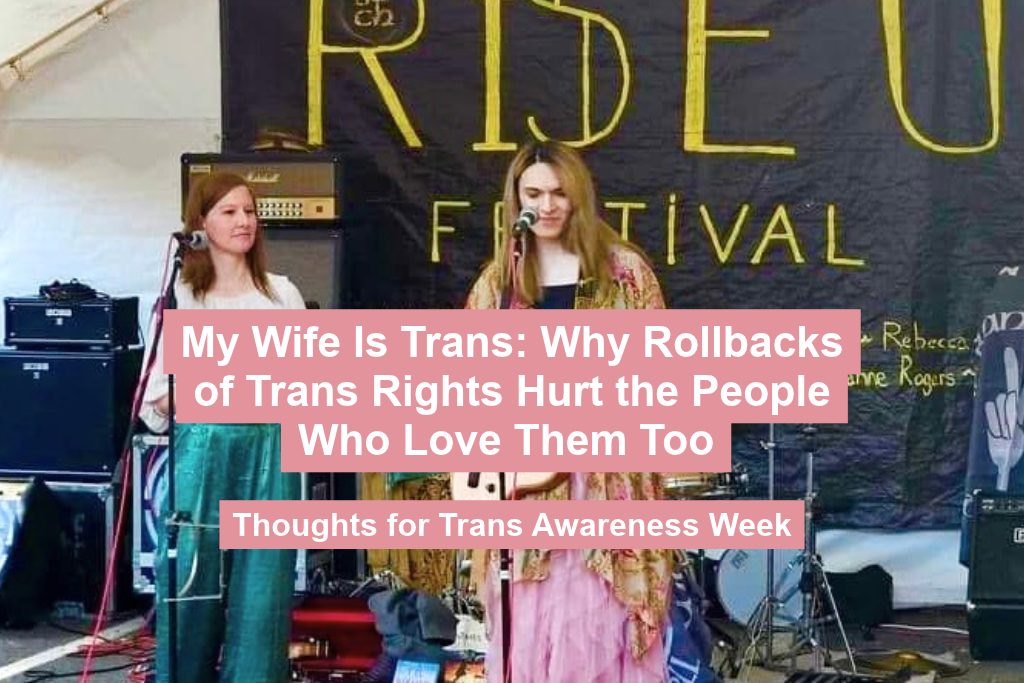
In May 2024, my wife and I played a local music festival, celebrating bands fronted by women. It was a great gig, with a lovely audience, including plenty of our friends.
My wife and I have been married for a (lucky!) 13 years, having met during our training as a psychologist (me) and a psychiatrist (her). We live in a nice house in a pretty part of the world, have friends, family and a cute little cat. We’ve been gigging together for the last decade.
My wife is my best friend. We share our lives together, doing the normal things couples do: hanging out with friends, going out to the cinema or dinner, having a cup of tea on the sofa, feeding the cat, divvying up the chores.
Our life is as ordinary as they come, except for one tiny detail: my wife is trans.
My wife transitioned in 2019, which was a whole rollercoaster ride for us as a couple. Happily, we arrived on the other side as much in love as ever, but navigating life as a trans person or as a queer couple has never been easy. And following the 2025 Supreme Court ruling – which ruled that “sex” in the Equality Act meant “biological” sex only – things have only got harder.
How Rollbacks of Trans Rights Affect Everyday Life
My wife has a package she needs to post.
“I’ve found out I can use one of the drop off boxes”, she says. “That way I won’t have to talk to anyone.”
“Got you!” I say. “That makes sense.”
When I stop and think about it, I know it’s weird. But my wife talking to a stranger at the Post Office is fraught. How will they look at her, will she be misgendered? Easier to use the person-less drop-off box instead.
Same when it comes to calling the utility companies – I make the phone calls these days. It’s too complicated when the person on the other end can’t see my wife, only hear her voice. She’s on an NHS waiting list for vocal training, but it’s been four years and she’s still not at the top.
Right after the Supreme Court ruling we had tickets for a comedy night, booked months in advance with one of our favourite comedians. Did we still want to go now? What would we do in the interval? Apparently, my wife wasn’t supposed to use the women’s toilets any more.
The Anxiety of Navigating Gendered Spaces
On the night, my wife tried to do the right thing: use the gender-neutral facility next to the women’s. But it was full entirely of men – so she walked straight back out. In the end, we hurried anxiously in and out of the – completely empty – ladies’ toilets together. What a pointless stress, what a way to spoil a night out.
A few months later, we went to a friend’s outdoor birthday party, where my wife queued for what she thought were the unisex porta-loos. These are for men only, a man behind her told her, kindly. The women’s loos are inside.
The toilet thing is dumb, but also huge. As a professionally-trained singer, my wife used to work for a charity as a peripatetic music tutor. She’s given that up since the ruling, as she can never be sure she’ll have somewhere suitable to pee.
And now there’s the issue of hospital wards, too. My wife is terrified of getting ill or injured, and being placed on a male ward. I’m terrified that if she needs admission to hospital, she won’t go.
We haven’t been out for dinner or away on holiday for ages. Being around people we don’t know is scary, and being on edge is exhausting. Even people you think will be fine with a trans person might not be, because what kind of messaging are ordinary members of the public being given? My wife feels like the Supreme Court ruling broke something fundamental inside her. I feel shamed, completely invalidated, she told me. Like the State is insisting that who I am doesn’t exist.
How Transphobia Affects Relationships, Friendships and Everyday Conversations
Last year, I switched to a new massage therapist. She likes to chat and she often asks about my life. I’ve told her about my wife’s singing career, about how she used to be a doctor – a consultant military psychiatrist – how she’s half-Japanese, how she loves Haribo and hates pretty much all sports. I love my wife, and I like talking about her. But I haven’t told my therapist that my wife is trans. I just don’t know how she’ll react.
Doesn’t have to be outright transphobia – though obviously there’s plenty of that any time you turn on the radio, a news app, Facebook or the TV.
A few months ago, I went for a drink with a friend in the village pub. Another friend of his wandered over, just as I was talking about the volunteering I do. “Who’s that with, then?” he asked. “A trans rights organisation,” I told him. “Oh, trans,” he replied. “I can’t be doing with all that.”
Trans Rights Aren’t Just Politics. They Affect Real People’s Lives.
Lots of people are like that: they don’t want to know, they can’t be bothered. They don’t want to talk “politics”, they don’t want to get involved in any “toxic debates.” But the thing is, for me and my wife, it isn’t “politics” or some abstract, intellectual debate — it’s our day-to-day lives. It shapes so much of our relationship as a couple: where we go, what we do, what takes up our energy, what gets in the way of us just loving each other and enjoying our shared life.
There are people like me and my wife all over the country: trans folk and their cis partners, cis parents and trans children, trans parents and cis kids, cis and trans siblings, cis and trans friends, all muddling along together. So often, trans people are painted as a tiny, marginalised group. And that’s true, but what it misses are the hundreds of thousands of people who surround them.
Trans Awareness Week: Standing Together for Trans Rights
On Trans Awareness Week, this is what I want to highlight. Trans people are not alone in this fight – they are not some abstract concept. They are our siblings, partners, children, friends, and policies that hurt them also hurt us. Trans people are part of our families, workplaces and communities. There are hundreds of thousands of people like me who love them, and who have a heck of a lot of skin in this game, too.
Which means there will be hundreds and thousands and ultimately millions of people who will fight for their rights, because cis and trans people belong together – just like me and my wife.
If you’re a woman who also questions why things have become so hostile towards trans people, and doesn’t agree that our trans+ friends and loved-ones should be excluded from taking part in everyday life, please sign our letter – Not In Our Name: Women in support of the trans+ community