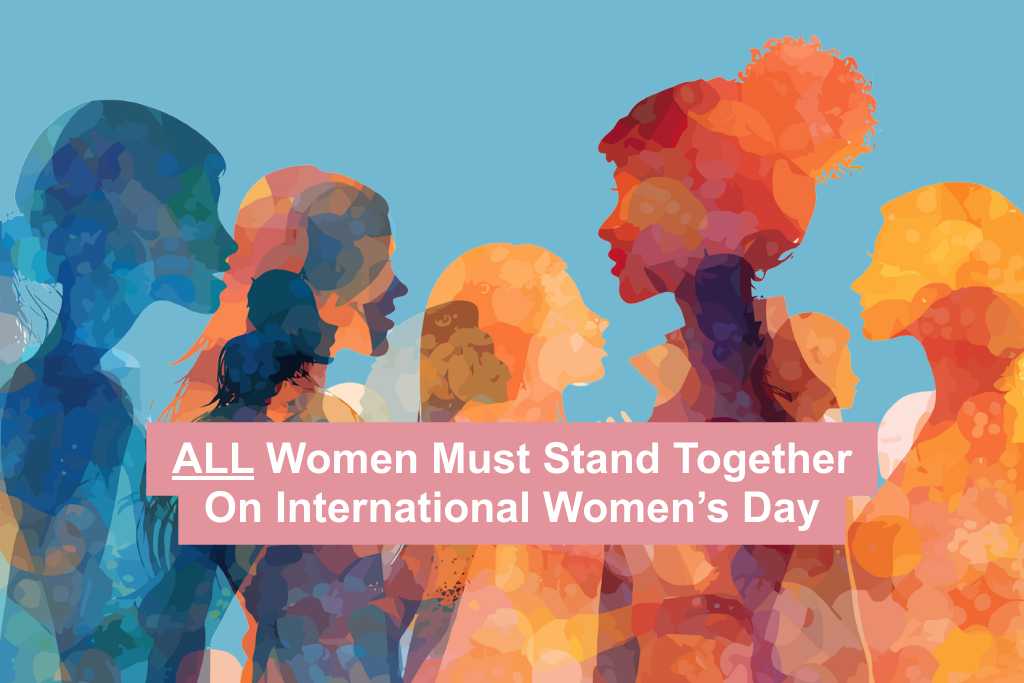
This International Women’s Day, we believe it’s more important than ever for women to stand together. And by that, we mean ALL women.
In our society and across the world, we still face so many challenges, including appalling rates of misogyny and gender-based violence. Gender inequality remains rife and women’s healthcare, including sexual and reproductive health, is often woefully lacking.
In these difficult times, we’re learning just how much our rights matter, and soberingly, that we cannot take them for granted.
And yet, recently, women have become painfully divided.
This division between women, including between cis* and trans women, is not accidental. It’s not inevitable, and it didn’t happen overnight.
For the last ten years or so, the “debate” around “trans rights” has become increasingly prevalent – in politics, on social media, and in the press. We’re seeing how arguments around trans rights are being deliberately used to manufacture political divisions between us, separating those who would naturally stand together.
When women are divided in this way, it weakens our ability to challenge the real sources of violence, discrimination and gender oppression.
It also opens the door to ideas that are deeply harmful not just to trans people and the LGBTQ+ community more generally, but to ALL women.
Many of those who deliberately target trans rights — under the guise of “protecting women” — are part of a movement that seeks to restrict rights and freedoms more generally. In this context, trans people are often the “canary in the coal mine”.
We’ve seen how attacks on trans people’s inclusion, equality and bodily autonomy, have opened the door to campaigns that target same-sex marriage and same-sex parental rights, seek to restrict sexual and reproductive healthcare, and challenge the fundamental principles of gender equality.
Right now, women like us are being repeatedly told that the most pressing threat to their rights and safety are trans people – not cis men who abuse their power, not the systems of gender inequality that so many of us experience and observe day in, day out — but a population that represents less than 1%.
Just think about that: 51% of the population (cis women) threatened by less than 1%… the maths just doesn’t add up.
The reality is that our trans siblings — and trans women in particular — face so many of the same threats and challenges that we do:
- Sexism
- Misogyny
- Violence
- Discrimination
- Inequality
- Difficulties accessing healthcare
- Threats to bodily autonomy and choice
If we turn against our trans siblings – and against each other – we only end up deepening the divisions that others are so keen to sow amongst us.
So, on International Women’s Day, let’s remember and celebrate everything that we women have in common, regardless of age, race, background or faith. And let’s do something that, as women, we do so well.
Let’s reach out, strengthen our connections, and even make new ones — with friends, neighbours, colleagues, or even strangers ❤️ Let’s come together once again and stand in solidarity to achieve our shared goals of equality, safety and liberation.
* ‘Cis’ or ‘cisgender’ means someone who is not transgender. When first engaging with those not familiar with this language, we sometimes use “women” to refer to our collective or our signatories. However, for clarity, the NION definition of “woman” absolutely includes trans and cis women together.