Published to mark LGBT History Month 2026
If you’ve been following the debate around trans rights over the last few years, you could be forgiven for thinking this is a new conflict, that women and trans people have always been on opposite sides, and that the question of whether to be inclusive of trans women is some fresh, unsettled frontier.
It isn’t. And this LGBT History Month, we wanted to share some of the history that often gets left out, because it turns out, women have been standing up for trans people for a very long time.
The story runs through music venues and festivals, through grassroots collectives and handmade zines, from a recording studio in 1970s Los Angeles to a drama on the BBC last autumn.
It’s a story about women who saw another woman being treated unjustly and decided they weren’t going to stay quiet about it. Sound familiar?
A recording studio, a trans woman, and a decision that mattered
We’ll start in Los Angeles in the 1970s, with a feminist music label called Olivia Records.
Olivia was a collective of lesbian women making music by, for and about women – independent, radical, joyful. And they employed a trans woman named Sandy Stone as their sound engineer. Sandy was brilliant at her work, and by all accounts deeply loved by her colleagues.
When word got out, some people objected, loudly. Letters were written demanding Sandy be removed. There were protests at concerts. Some demanded that Olivia choose between their trans colleague and their audience.
Olivia chose Sandy.
They stood by her. They made clear that she was one of them, that she belonged, and that they weren’t prepared to define womanhood in a way that excluded her. Eventually, under sustained pressure that created real difficulties for the collective’s work, Sandy made the decision to leave in order to protect the label she cared about. But Olivia’s position never wavered. Decades later, members of the collective have spoken warmly about Sandy and about that period, and the friendships formed then have endured.
This happened in the late 70s. Nearly fifty years ago.
“Most people I talked to were horrified”
Fast forward to 1991 and a large women’s music festival in rural Michigan called the Michigan Womyn’s Music Festival – known to many as Michfest. It had been running since 1976: thousands of women camping, making music, building community.
That summer, a trans woman named Nancy Burkholder attended the festival. When it was discovered she was trans, she was asked to leave, at night, without even being allowed to return to her campsite for her belongings.
Her friend Janis Walworth, who was not trans, was furious. She spent the rest of that festival walking from group to group, telling women what had happened. Her account of those conversations is striking: “Most people I talked to were horrified.”
That response – not the exclusion, but the horror at it – is the part of this story that often gets forgotten.
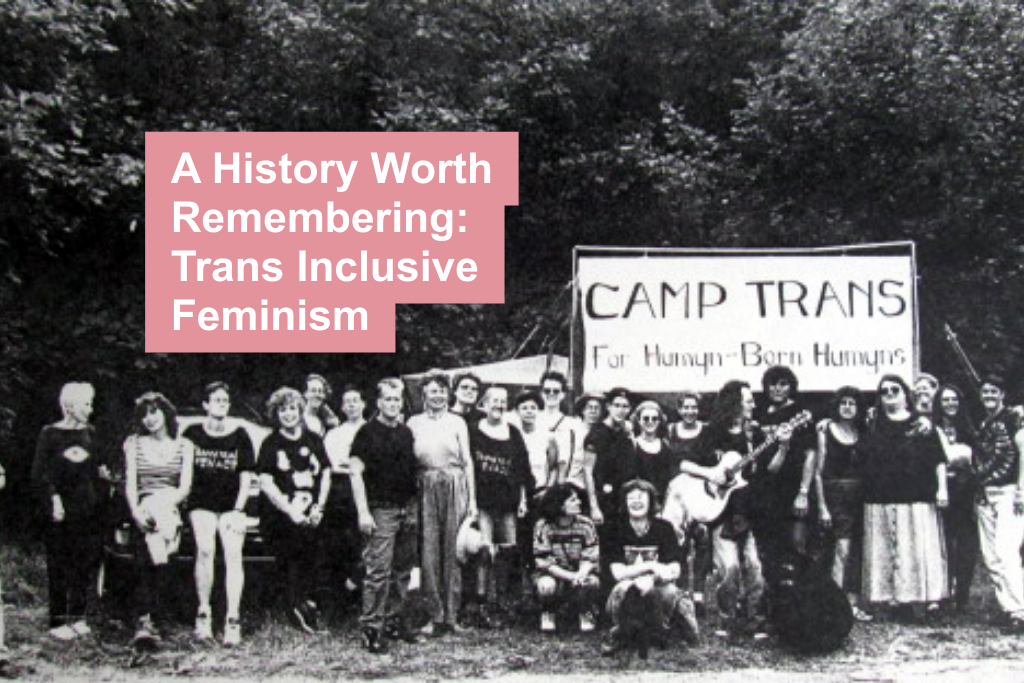
Janis didn’t stop there. The following year she returned with a small group, including trans women and their supporters, setting up just outside the festival to hand out leaflets and hold conversations. These early protests eventually became what people called Camp Trans. It ran, on and off, for years. What began as a small protest eventually helped shift the conversation inside the festival itself. Women who attended Michfest heard the arguments, thought about them, and many changed their minds.
The conversation continued for years because women inside the community were asking whether exclusion truly reflected their values. The process wasn’t neat, it involved disagreement and reflection and ultimately arrived at an impasse. The festival did not officially change its position and it closed in 2015, but it remains an example of something healthy: women holding their own spaces accountable and allowing them to evolve.
Black feminism and the solidarity that was always there
While some feminist spaces were working out where they stood on trans inclusion, others had already been clear for decades.
In 1974, a group of Black feminist women in Boston formed the Combahee River Collective. Their politics were built on the understanding that different kinds of oppression – racism, sexism, class, sexuality – are bound together, and that you can’t fight one while ignoring the others. Their landmark 1977 statement is still read and taught today.
The Collective built a framework that centred queer and trans Black women’s experiences. To them, this wasn’t a complicated question. Their whole framework was about recognising the full humanity of people who faced multiple, overlapping forms of discrimination and trans women of colour absolutely belonged in that picture.
This matters because it’s a reminder that the history of women supporting trans people isn’t only a white, middle-class story happening in music festivals. It’s woven through Black feminist thought, through the politics of women who had good reason to know what it felt like to be told you didn’t belong.
Riot Grrrl: messy, complicated, and ultimately growing
In the early 1990s, a new feminist punk movement called Riot Grrrl erupted out of the music scenes in Olympia, Washington and Washington D.C. It was loud, DIY, furious, and it put women’s experiences – including sexual violence, body image, and structural inequality – at the centre of its art.
Like many movements, it was complicated on trans inclusion. Some of its prominent figures were involved with Michfest during the years when trans women were excluded. Trans women were largely invisible in the early scene. This is part of the history too and it’s worth acknowledging honestly.
But Riot Grrrl also contained within it the seeds of something more expansive. Its whole ethos was about refusing to be told who you were, about making space for voices that had been shut out. It attracted queer women, women of colour, women who didn’t fit neatly into anything. And over time, those values led many in the scene toward a more explicitly trans-inclusive politics.
Kathleen Hanna, one of Riot Grrrl’s founding figures and frontwoman of Bikini Kill, has been explicit and consistent in her support for trans rights. The scene that grew from those early days became something wider, messier, and more welcoming than it started out.
Ladyfest: taking the spirit worldwide, and taking everyone with it
Out of that Riot Grrrl spirit grew Ladyfest, a grassroots, do-it-yourself festival model that began in 2000 and spread around the world. Volunteer-run, not-for-profit, explicitly feminist and explicitly inclusive.
Ladyfest festivals have run in cities across the UK, Europe, North America and beyond, each one organised locally but connected by shared values. From the start, those values included trans inclusion. Ladyfest London’s own description of what they do talks about being “non-exclusive” and welcoming to “all feminist peoples.” The festival was never conceived as a space that needed to decide whether trans women were women. They just were, and the doors were open.
That might sound like a small thing. But when you consider how much noise was being made in some quarters about the dangers of including trans women in women’s spaces, the quiet, consistent openness of the Ladyfest model is its own kind of statement.
Present day: the tradition continues
The same spirit carries through to today. Out & Wild is a UK-based women’s and non-binary festival that is openly and proudly trans-inclusive – it’s built into the very foundation of what they are and who they’re for. No asterisks, no small print. Just a festival for women that means all women.
And then there’s Riot Women – a BBC drama that aired last year, about five middle-aged women in a small West Yorkshire town who form a punk band. The cast is full of brilliant, experienced British actresses. And one of the band’s members is Risi, a trans woman, played by Macy Seelochan. Her trans identity is part of her character, but it isn’t the drama. She’s just a woman in a band with other women, navigating the same life that all of them are navigating.
Macy has spoken about what it meant to her to play the role, to be part of a story where a trans woman simply exists, is loved by her friends, and gets to be funny and messy and human. The show’s setting, its punk-feminist energy, its Yorkshire grit – it’s a direct line from those 1970s collectives and 1990s zine scenes to a primetime BBC drama in 2025. The thread is unbroken.
Why this history matters right now
We know the current moment feels heavy. There’s a lot of noise, a lot of hostility, and it can feel like there is pressure to conform to the belief that women who support trans people are going against the grain – breaking with something, taking a risk, stepping outside the mainstream of women’s experience.
But we hope this history shows something different. The women who stood with Sandy Stone in the 70s were not radicals acting alone, they were part of a long tradition of women who looked at another woman being treated as less-than and said: not on our watch. The women who built Camp Trans, who organised Ladyfest, who created Out & Wild, who wrote and created Riot Women – they are all part of the same thread.
And the list goes on…
The recent After Section 28th Conference which made it abundantly clear that the T is very much an integral part of the fight for equal rights, and who made us so welcome at their recent event, which was all about learning from history.
And of course, the women and girls of the WI and Girl Guiding, who when pressured to exclude their trans siblings – after decades of inclusivity – showed they would rather give up the group altogether than reject their friends.
85,000 women have now signed our letter. They are mothers and daughters, colleagues and friends. Many of them had never called themselves activists. They just looked at what was happening and thought: this isn’t right. And they added their name.
That’s all this has ever taken. Women who notice injustice and decide not to be quiet about it.
That tradition is older than any of us. And it’s still going.
If you’d like to add your name to our letter, you can find it here.